Hi Bourbon enthusiast
You must be 21 or over to enter this website. If you're not old enough to drink, then you're not old enough to read Breaking Bourbon.
Please read and drink responsibly.
You must be 21 or over to enter this website. If you're not old enough to drink, then you're not old enough to read Breaking Bourbon.
Please read and drink responsibly.
Anyone who has tried to create their own bourbon blend or infinity bottle with bottles in their collection knows how difficult it is to come to a result that isn’t a muddled, incoherent mess. Though blending has always been an integral part of scotch, bourbon producers have largely steered clear of it until the last decade or so. That has helped Lost Lantern take on one of the most challenging blending projects in American whiskey history. While multi-distillery blends have grown in popularity, they typically feature only 2-3 distilleries. Taking it to the next level, Lost Lantern sought to craft a 50 distillery blend bringing together bourbons from all 50 states, which could easily be seen as an impossible project for the small company. Yet they were determined to prove that not only could it be done logistically, but it could be done with far more precision than anyone ever expected.
Lost Lantern is an independent bottler of American whiskey based in Vermont. The company seeks out distinctive spirits from craft distilleries across the United States and releases them as co-branded single barrel casks and carefully crafted multi-distillery blends. Founded by husband-and-wife team Nora Ganley-Roper (general manager and head blender) and Adam Polonski (whiskey cask hunter), the company operates like traditional independent bottlers in Scotland, but with a uniquely American focus.
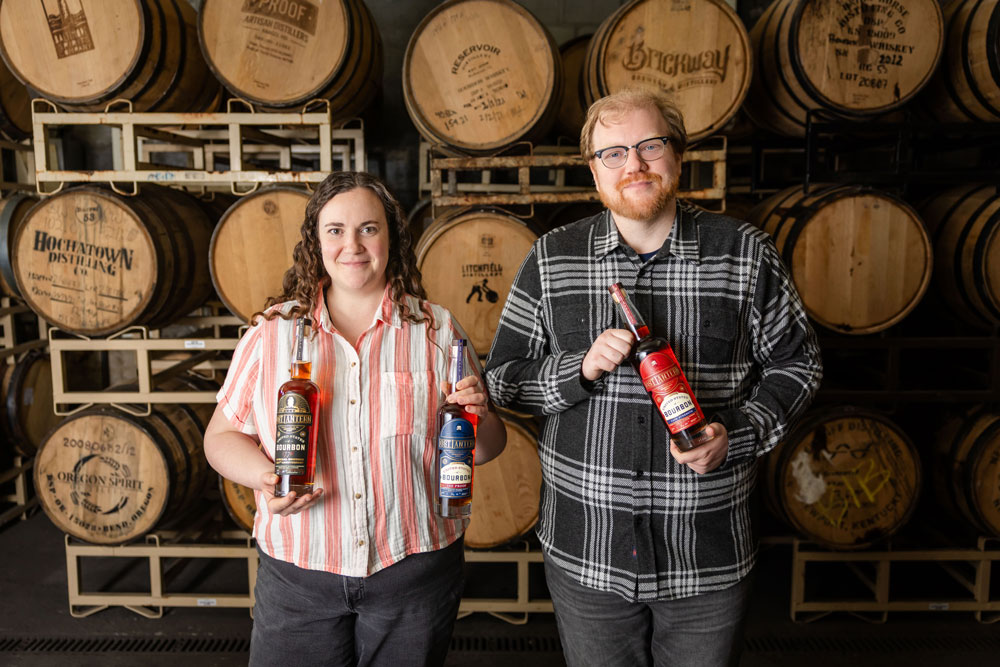
Though the 50-state/50-distillery blend, dubbed “United States of Bourbon,” coincides with the United States’ 250th Anniversary, the idea for the project was born on a road trip in 2018, before the company officially launched. While they had no immediate plans to tackle such a colossal project themselves, they kept it in the back of their minds, hoping to attempt it before anyone else.
"As we started working with more distilleries and visiting even more places around the country and seeing that there really was an increasingly high quality whiskey being made all across the country, and continuing to get better, it started to come into focus as, ‘this is something not only that we could do, but also could do and have it be both good and also interesting and exciting,’" says Ganley-Roper.
In 2020, the team took their first steps towards making the project a reality and bought barrels from a Vermont distillery that was closing. "At that time, it was the only bourbon in Vermont that was being aged in full-size barrels, so we wanted to lock that in when we could," Ganley-Roper says. Although full-size barrels were not a strict requirement for “United States of Bourbon,” they were used whenever possible.
At this early point, Ganley-Roper and Polonski didn’t have hard rules set in stone for the project, but some rules and philosophical guidelines were beginning to take shape as the project progressed. The most obvious one was that the bourbon had to be distilled in the state the distillery was located in - so no sourced bourbon brought in from one state to be aged in another.
Ganley-Roper and Polonski also wanted to personally visit every participating distillery to verify authenticity. As with all of Lost Lantern's releases, they want to showcase the influence of local climate, grain, and production methods on the bourbon itself. Lost Lantern’s United States of Bourbon was truly meant to be a mingling of the United States’ vast geography and the ways different terroirs interacted.
Another critical requirement was that every component of the blend had to be straight bourbon. “To make it clear that there's nothing else in this, it was just bourbon,” Ganley-Roper says. Meaning, no whiskey types other than bourbon, no additives, and no specialty blending components outside of straight bourbon. This also meant no finished bourbon, as they wanted the bourbon to represent itself.
A “one distillery per state” rule was soon adopted, which seems obvious given the scope of the project, but it ultimately came down to ensuring equal representation for every state and no state receiving extra weight for having multiple distilleries.
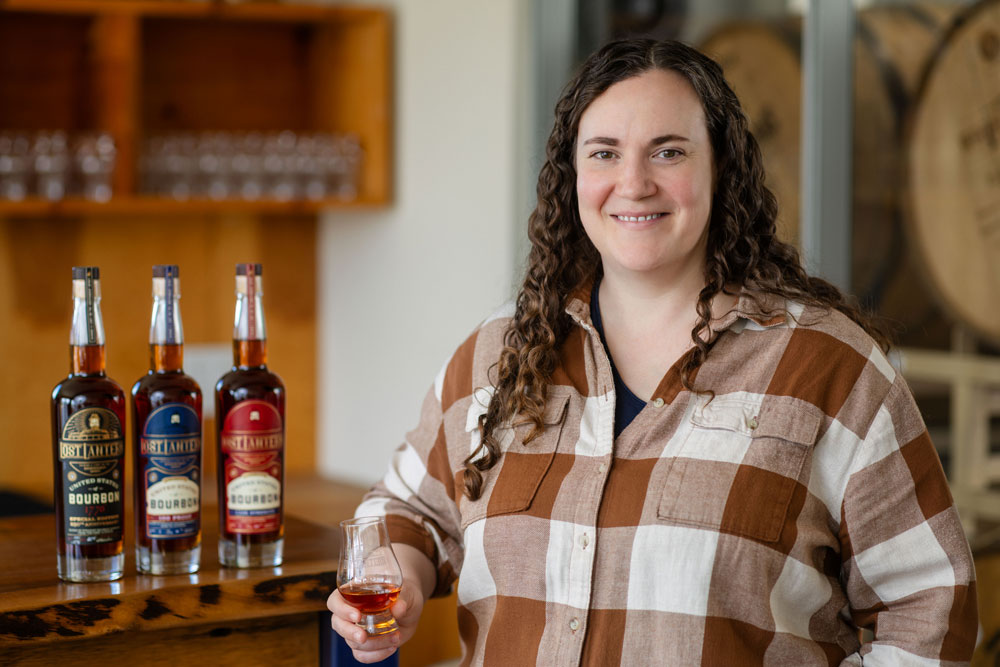
They also continued to use the company’s philosophy of working with distilleries they personally believed in. "It had to be a distillery that we were excited to talk about,” Ganley-Roper says. "Ideally, the place that we thought was making the best or some of the best bourbon in that state.”
These guidelines helped keep a project that was at risk of being unwieldy in check. It allowed Ganley-Roper and Polonski to focus on which distilleries they wanted and which types of whiskey they could ignore - almost like a real-life game of “Guess Who.”
The most challenging states included Alaska, Hawaii, Mississippi, North Dakota, South Dakota, and particularly Idaho. "Idaho was one of the two that was closest to killing the whole thing,” Ganley-Roper says.
“I spent about a week in Idaho, visiting a ton of places. [But] I didn't find really any bourbon at all that was actually being made there. And I left Idaho and was really worried about [the project]. I was getting to the point where I'm like, ‘Do I ask Warfield to distill a bourbon for us, and wait a few more years?’ And then I got a LinkedIn post from someone…announcing that he was about to release his 8 year old Idaho bourbon brand that had been under wraps for 8 years called Days Defile. It was actually distilled and aged there, the first straight bourbon from Idaho, and I was in Salt Lake City, like, the next week, and said, okay, ‘I'm gonna come up and visit you and make this happen.’”
Once all of the barrels were procured, which took the team all the way into early 2026, the true test began: blending. How does a blender take so many individual components with vastly different flavor profiles and hope to create something cohesive? The answer: time management, compartmentalization, and a clear end goal.
Ganley-Roper and Polonski wanted the United States of Bourbon to be approachable, and one that any bourbon drinker could find some familiarity with. Given the wide range of flavor profiles Lost Lantern's single barrel releases feature, Ganley-Roper wanted "Someone who doesn't know a lot about bourbon has to know this is bourbon." The bourbon identity had to remain obvious with core flavors people wouldn’t find polarizing.
"I could have blended something that was really pushing the boundaries, so off the beaten path that it would be really divisive, but that was not the intent of this," Ganley-Roper says.
The blend also had to taste cohesive, an element Ganley-Roper repeatedly emphasized. "The hardest thing is making sure that it doesn't taste like 50 different distilleries."
Rather than trying to blend dozens of barrels simultaneously in what would have been an impossible task, Ganley-Roper broke the project into three separate blending projects, using a layered mini-blend approach. “It might be 40 different mini blends that we go through before I lock it in. And we will take the time that it takes to get to that point from a flavor profile perspective,” Ganley-Roper added.
It started with the foundational core blend, which Ganley-Roper says accounts for two-thirds of the blend. “With that base, it's building the overarching player profile. It generally doesn't have the full mouthfeel or structure, but it dictates the direction of the whiskey. And for this, it needed to be basically good enough to stand alone.”
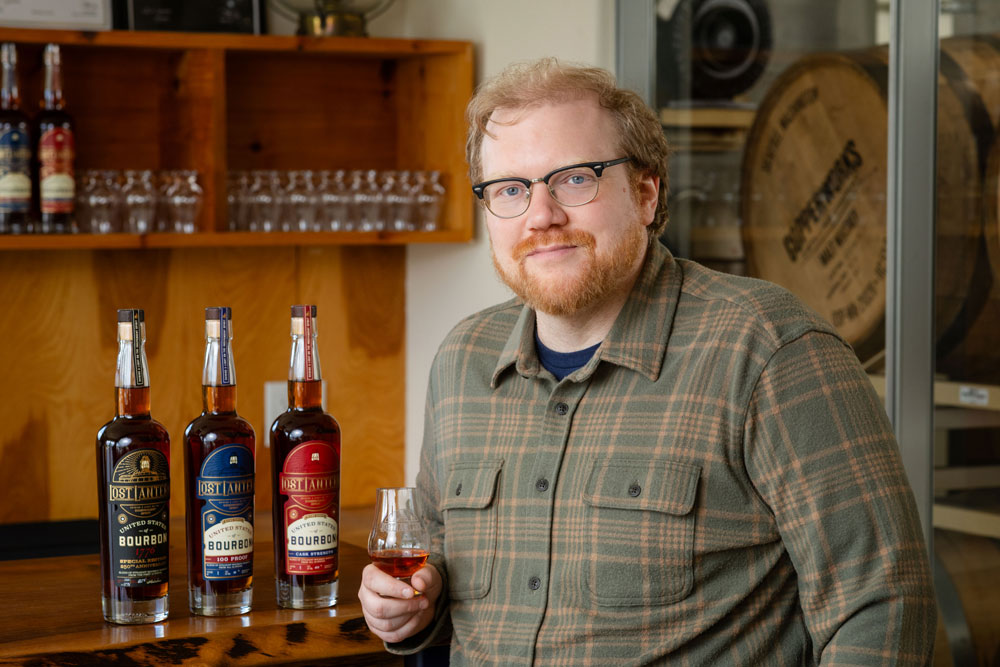
Once the base blend was complete, Ganley-Roper treated that entire blend as a single component. Instead of managing dozens of individual barrels, she could now work with the completed base blend, adding additional barrels she singled out, and focus on new flavor accents. This is where additional complexity was built, improving structure and overall balance.
The final layer was one she repeated multiple times to get right. At this point, Ganley-Roper wasn't blending individual barrels from scratch anymore. She was blending increasingly refined and balanced bourbon layers together. Here is where fine-tuning occurred, adding nuance and ensuring all 50 states were represented without overwhelming the bourbon.
“It's like, when you're cooking, you have the meat, and so the base is the meat, and then you have the sauce, and then you have the herbs, and salt and pepper, and stuff like that, and that's how I think about it, from a blending perspective,” Ganley-Roper says. “But it is distinct, so that I can, as much as possible, bite-size it.”
Once Ganley-Roper felt a blend was complete, Polonski acted as a quality-control gatekeeper. "[If] he doesn't think it's done when I bring it to him, I have to keep going," Ganley-Roper says. Simply, the blend wasn't finished until both founders agreed.
The full blending effort took more than a month, and with the United States' 250th Anniversary approaching, the clock was ticking. Though the United States of Bourbon 100 proof and cask strength releases aren’t specifically designed for the anniversary, the timing is certainly serendipitous. Along with these releases, the duo is also releasing a one-time, limited 1776 Edition that ties into Independence Day festivities and blends 13 distilleries from the original colonies with a higher average age statement.

Given the amount of logistics involved, the cost of the barrel, long-term barrel inventory, the amount of traveling involved, and a baby on the way, this was no small task for a company of any size, let alone one of Lost Lantern’s size. With the 100 proof release priced at $80 and the cask strength at $100, it was really important for these two releases to be accessible not only by flavor but also by price to a wide range of bourbon drinkers, Ganley-Roper says.
The three United States of Bourbon releases are the largest yet for Lost Lantern, totaling approximately 11,856 bottles. Early word-of-mouth has led to sellouts of the 100 proof and cask strength versions, but more is on the way, according to the company. They also plan for it to be an annual release, and, given the number of components involved, bourbon drinkers should expect each annual release to have welcome variations. But not too much, Ganley-Roper adds, to help maintain continuity, they are saving some of the original blend to serve as the foundation for future batches.
Given the number of distilleries involved for this release, Ganley-Roper and Polonski were surprised the project wasn’t leaked. "Every one of the distilleries was very excited to be part of it,” Ganley-Roper says. Since releasing the bourbon, the duo has received a lot of well-deserved attention, but one unexpected takeaway was that many people still think bourbon can only be from Kentucky. "Bourbon can truly come from anywhere in the United States,” says Ganley-Roper. Lost Lantern’s United States of Bourbon is proof that while individual identity is important, working together can create "a more perfect Union.”





.png)