Hi Bourbon enthusiast
You must be 21 or over to enter this website. If you're not old enough to drink, then you're not old enough to read Breaking Bourbon.
Please read and drink responsibly.
You must be 21 or over to enter this website. If you're not old enough to drink, then you're not old enough to read Breaking Bourbon.
Please read and drink responsibly.
Classification: Straight Bourbon
Company: Brown-Forman
Distillery: Old Forester Distillery
Release Date: July 2026
Proof: 115
Age: NAS (Aged at least 4 years per TTB regulations)
Mashbill: 72% Corn, 18% Rye, 10% Malted Barley
Color: Dark Gold
SRP: $65 / 375mL (2026)
Barrel char | Smoke | Vanilla extract | Charcoal | Clove | Blackberry | Black raspberry
Dark brown sugar | Stewed fruit | Plum | Apple cobbler | Pecan torte | Vanilla
Charred oak | Seasoned oak | Bootstrap molasses | Cigar tobacco
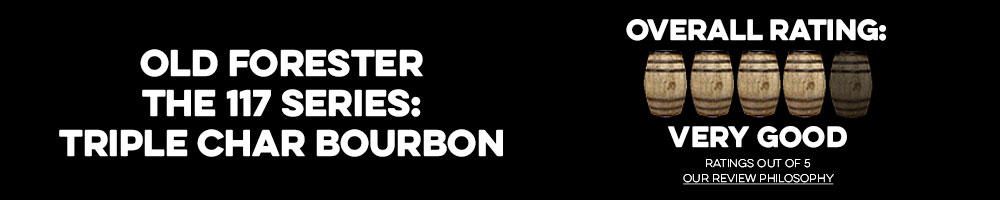
Old Forester 117 Series Triple Char Bourbon puts its extreme barrel char to work, delivering a surprisingly rich, sweet, and fruit-forward bourbon with pronounced char on the finish without the excessive dryness and tannin you’d expect it to have.
Triple Char Bourbon is the newest release in Brown-Forman’s 117 Series and the first Old Forester bourbon to be crafted entirely from whiskey distilled at Old Forester Distillery in downtown Louisville’s historic Whiskey Row. The distillery is located in the same building where Old Forester operated from 1882 to 1919. The distillery opened in 2018 after a $45 million renovation, bringing fermentation, distillation, barrel making, aging, and bottling back to the heart of downtown Louisville. Also noteworthy is that the location features an on-site cooperage, allowing a small percentage of barrels to be made and charred in the same facility where the whiskey is produced and aged.
Triple Char Bourbon was aged in barrels charred three times longer than traditional Old Forester expressions. Old Forester chars its standard bourbon barrels for 20-22 seconds, meaning Triple Char Bourbon undergoes a 60-66 second burn. Typically, Barrel Char Level #4 is the maximum standard and is a 55 second burn, creating an alligator-like skin texture, and where the char level gets its "alligator char" nickname. Interestingly, Old Forester 1910 Old Fine Whisky underwent a second barreling that former Old Forester Master Taster Jackie Zykan said, “The second barrel is charred nearly to the point of incineration.”
Given the amount of burn Triple Char Bourbon’s barrels experienced, the bourbon isn’t nearly as smoky or sooty as you’d expect. Aromatically, barrel char leads, followed by smoke, vanilla extract, charcoal, and clove, but they combine into an all-around rich, oaky bearhug. The palate doesn’t even feature much charred oak, instead offering rich notes of dark brown sugar, stewed fruit, plum, apple cobbler, pecan, and vanilla. During the finish, though, char makes it triumphant return, and it dominates the sip from here on out.
Though oak-heavy bourbon is more common in the market than ever before, there is a likelihood that a large portion of consumers will love what Triple Char Bourbon has to offer. Thanks to its higher proof of 115, compared to Old Forester 1910’s 93 proof, it has a greater overall richness that brings out more sweetness. Old Forester 1910 is more of a low simmer, leaving a smokier aftertaste. By comparison, Triple Char is also surprisingly fruity in places, and its char content is a nice change of pace compared to the onslaught of double-oaked bourbons on the market. Some may see this as splitting hairs between the styles, but Triple Char Bourbon doesn’t feature anywhere near the amount of dry oak, tannin, bitterness, and astringency that you’d expect with this amount of char. Perhaps it took years of (over)exposure to double-oaked bourbons to get acclimated to such aggressive barrel treatment; regardless, Old Forester The 117 Series: Triple Char Bourbon works.







.png)